News
7th October 2026
Join us at Electronica 2026 - Meeting Slots Now Open
News
6th October 2026

Head of Marketing
Join the AntennaWare team at electronica 2026 at Booth C2.608
AntennaWare will exhibit at electronica 2026 in Munich from 10 to 13 November 2026. You'll find us in Hall C2 at booth 608.
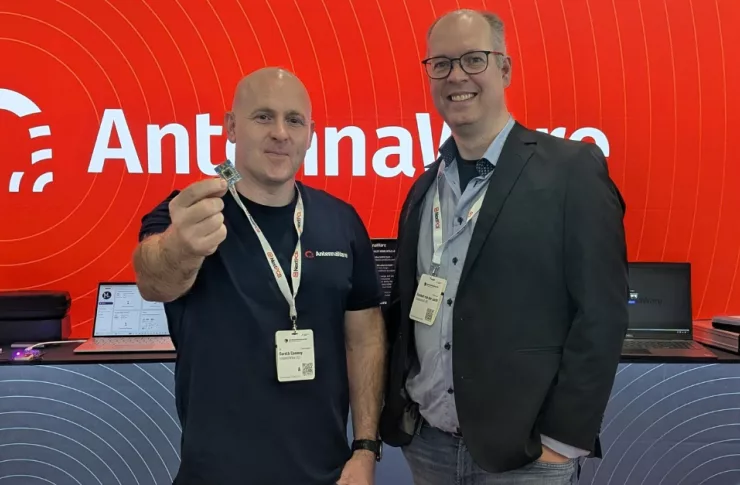
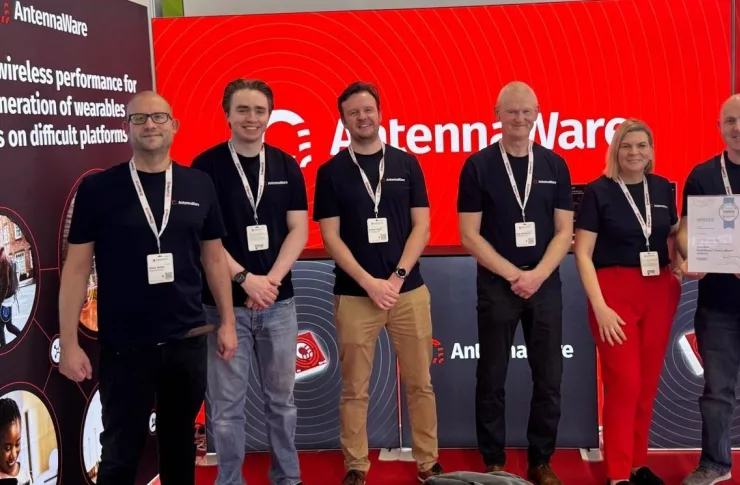
Come and meet the AntennaWare team. Gareth Conway, our CEO and co-founder, will be at the show with our field application engineers and commercial team. We will be running live demonstrations at the booth, showcasing our range of antennas throughout the show.
Visit us to see BodyWave™ and Omni-Wave™ in action, talk to our RF engineers, and see what robust, reliable, and repeatable performance looks like when the right antenna is designed in from the start.
We hope to see you there!
Live Demonstrations on the Stand
At the event, our team will be holding live demonstrations, including medical sensing, automotive, RTLS, wireless audio, and distributed sensing.
Ultra-wideband RTLS: SFM11-MOD by SynchronicIT
See our joint UWB module with SynchronicIT, which brings BodyWave™ antenna technology into a format built for body-worn tracking. Built around the NXP Trimension™ SR048, it is made for system designers moving to higher UWB channels, where body blocking has a greater effect on wireless performance.
UWB positioning accuracy depends on detecting the direct signal path. When the body blocks it, the receiver can lock onto a reflected path instead, and positioning errors increase. (More about the SynchronicIT SFM11-MOD module featuring BodyWave™).
BLE Channel Sounding: AN54LV-K15 by Raytac
The AN54LV-K15 development kit pairs Raytac’s BLE Channel Sounding module with three BodyWave™ antennas. It is built to evaluate Channel Sounding for asset and people tracking across different orientations and RF environments.
Channel Sounding estimates distance from the signal path, so when the body blocks the direct path, propagation around the body affects accuracy as well as range. In testing, the 2.4 GHz BodyWave™ antenna holds its resonance within band in free space and at 5 mm and 10 mm from a body phantom.
Sub-GHz Wireless Audio: Viviana Pebble by Raycom
The Viviana Pebble uses a sub-GHz BodyWave™ antenna in place of the whip antenna on wireless microphone transmitters worn in film, TV, theatre, and corporate production. Its rear surface acts as a ground plane, directing RF energy as creeping waves around the wearer’s body.
In Non-Line-of-Sight (NLoS) conditions, a Raycom walk test showed the Pebble’s range to be over double that of a traditional whip. It is compatible with transmitters from major wireless microphone brands, with SMA, SSMA, and LEMO cable options. Watch the walk test video on our stand.
Live VNA Comparisons
Our technical team will measure BodyWave™ on the body and Omni-Wave™ on metal alongside commercially available chip, printed, and flared monopole antennas. The vector network analyser (VNA) shows resonant frequency, which reveals detuning, and path gain, which shows how much transmitted power reaches the receiver.
When an antenna detunes due to the body or metal, its resonance moves away from the operating band. More power reflects back to the radio instead of radiating, and the effect grows the more the resonance shifts.
Path gain covers the whole link between two antennas, including detuning, energy absorbed by the body or the platform, and the signal’s route to the receiver. Lower path gain means shorter range, or more transmit power and battery drain to cover the same distance.
Book time with our engineers
If you have a specific design problem in mind, are designing a wireless product for challenging or dynamic platforms, or want to chat with our technical team about anything RF-related, booking ahead secures you a slot with our technical team during the show.
News
7th October 2026
News
14th September 2026
News
7th September 2026
News
17th August 2026
Videos
22nd July 2026
Follow us